Build your deck.
Create decks and cards the way you always have. Every card is stored under your account in Firebase Firestore, along with its full spaced-repetition (FSRS) scheduling state - so your review queue is always up to date, on any device.
VoxDeck turns any deck into a hands-free study session. It reads your questions aloud, listens to your spoken answer, and grades it with AI - a spaced-repetition study loop that keeps going while you cook, work out, do chores, or take a screen-free break, so whatever you're doing doesn't have to stop you from studying.
Most flashcard apps assume you have a free hand and a free screen. But a lot of real study time doesn't look like that - it's a walk, a workout, a load of laundry, the ten minutes before a shift starts. Anki-style review is powerful, but it's built for a desk, not a treadmill or a kitchen counter. So that time gets skipped, and the review streak that spaced repetition depends on breaks.
VoxDeck started as a question: what if the deck could study itself out loud? Instead of tapping through cards, the app reads your question, listens to what you say back, and tells you how close you were - correct, partial, or incorrect - using AI to judge the answer instead of a rigid text match. Everything else about spaced repetition stays the same underneath: your cards still carry full scheduling state, and every review still counts. Voice is just the interface for the moments your hands and eyes are already spoken for.
VoxDeck's hands-free mode chains four steps together - read, listen, grade, schedule - so a full review session can happen without a single tap.
Create decks and cards the way you always have. Every card is stored under your account in Firebase Firestore, along with its full spaced-repetition (FSRS) scheduling state - so your review queue is always up to date, on any device.
Start a study session and VoxDeck reads your question aloud using Apple's on-device speech synthesizer. Nothing is transmitted anywhere for this step - the audio is generated and played entirely on your device, even with the screen locked.
Say your answer and Apple's Speech framework transcribes it - on-device where the hardware supports it. Raw audio is never stored: it's discarded the instant it's transcribed, and the resulting text lives only in memory during your session.
Your transcript, the question, and the expected answer are sent to VoxDeck's grading service, which returns a verdict - correct, partial, or incorrect. The verdict and how long you took are saved to your review history; the transcript itself is not.
VoxDeck isn't a text-to-speech add-on bolted onto a flashcard app. Voice input and output are the primary interface. Here is what's inside.
Review an entire deck without touching the screen - questions are read aloud and your spoken answers are captured and graded automatically. Built for cooking, working out, walking, chores, or any moment your hands and eyes are already busy with something else, so whatever you're doing doesn't have to put studying on hold.
Powered by Apple's AVSpeechSynthesizer, running fully on-device - no audio or text ever leaves your phone for this feature. Audio routes automatically to Bluetooth headphones and speakers, and playback continues even when your device is locked.
Your spoken answer is transcribed with Apple's Speech framework, on-device wherever the hardware supports it. On older devices without on-device recognition, transcription may fall back to Apple's servers. Either way, VoxDeck itself never stores your raw audio.
A language model, served by Groq, compares your spoken answer to the card's correct answer and returns a verdict - no rigid exact-match required. No account identifier, email, or session token is ever included in the grading request.
Enter a question and a short explanation and Groq suggests three answer options; pick one or more and VoxDeck builds the cards for you. Optional, invoked only when you ask for it, and limited to 100 generations per day.
Every card carries its own free spaced-repetition scheduling state, so the cards you're shakiest on come back sooner and the ones you know well come back later - the same discipline as a traditional deck, just delivered by voice.
No ads, no ad SDKs, and analytics disabled in configuration. Your decks and review history are scoped to your Firebase account and visible only to you. Spoken-answer transcripts are held in memory only for grading and are never written to Firestore or saved to a file.
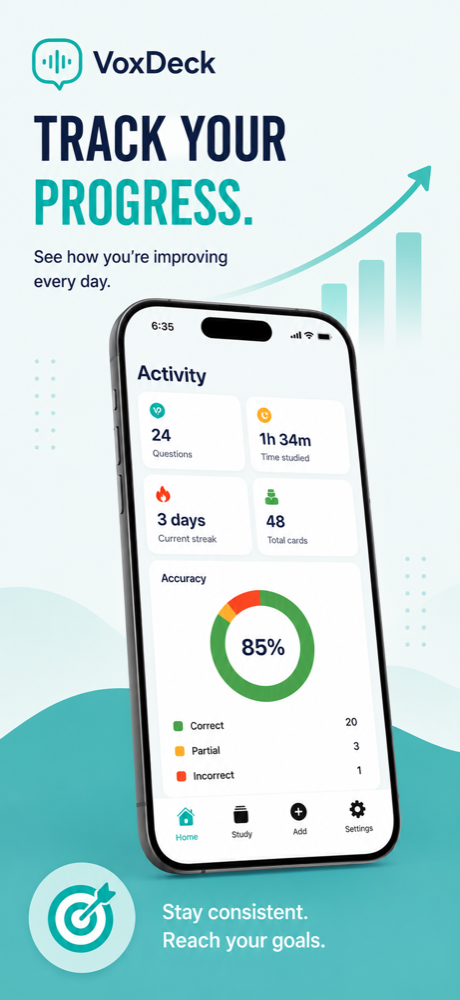
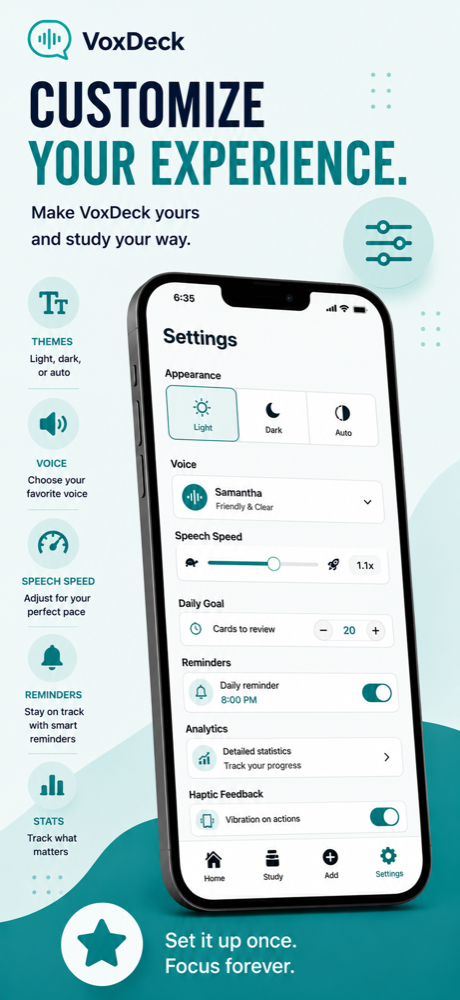
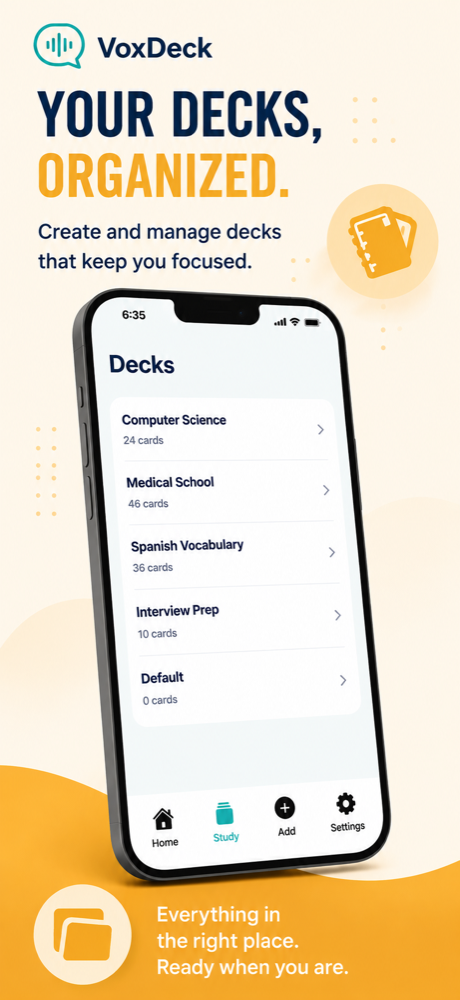
Set your voice, theme, and daily goal once; keep decks organized by subject; and watch your accuracy and streak build session over session.
VoxDeck is a solo-built iOS product - designed, architected, and shipped by one engineer. Every technical decision was made around one goal: make voice the primary interface without making the microphone a liability.
Text-to-speech runs entirely on-device via AVSpeechSynthesizer - nothing is transmitted for reading a card aloud. Speech-to-text requests on-device recognition whenever the hardware supports it, and raw audio is discarded immediately after transcription in either case.
When you use AI grading, only the card's question, its correct answer, and your spoken-answer transcript are sent; for AI card generation, only the question and explanation you type. No UID, email, or session token is included - the request can't be tied back to your account identity.
A Cloudflare Worker sits between the app and Groq, forwarding grading and card-generation requests and keeping API credentials server-side. That boundary lets the AI models evolve independently of the iOS client.
Firebase Authentication handles account identity with email and password. Firestore stores decks, cards, and review history - including FSRS scheduling state - scoped to your Firebase UID, so your material follows you across sessions and devices.
The audio session is configured for spoken-audio playback and routes cleanly to Bluetooth headphones and speakers. A background audio mode keeps text-to-speech playing even when your device is locked, so a session doesn't stop the moment your screen does.
Every layer - the SwiftUI app, the Firebase backend, and the Cloudflare-hosted grading and card-generation service - was designed and built end-to-end as a solo engineering effort, from the on-device speech pipeline to the deck-sync data model.
Grading is one of only two moments VoxDeck sends anything off your device - the other is AI card generation, when you choose to use it. Here's exactly what leaves during grading, what doesn't, and what's kept afterward.
VoxDeck is a solo-built iOS product - every layer, from the on-device speech pipeline to the cloud-synced deck model, designed and shipped by one person.
Software engineer building iOS products end to end - from SwiftUI interfaces down to the cloud services behind them. VoxDeck was built from a simple observation: flashcard study shouldn't stop the moment your hands and eyes are needed elsewhere.
The entire architecture - the SwiftUI app, Firebase Authentication and Firestore, the Cloudflare-hosted grading service, and the on-device Apple speech pipeline - was designed and built end-to-end as a solo engineering effort.